Dr. Maneesh Singh
MBBS (Hons. Gold Medalist) | MS (Gold Medalist) | Executive Director | NETRALAYAM The Superspeciality Eye Hospital Kolkata | Senior Consultant - Glaucoma and Cataract Services | NETRALAYAM VIP | Ex Consultant Sankara Nethralaya | Ex Treasurer Glaucoma Society of India | Executive Body Member and Jt Treasurer Ophthalmological Society of WB (OSWB)
NETRALAYAM (EM BYPASS)
The Superspeciality Eye Care Centre330, Barakhola, Mukundapur Main Road
EM Bypass, Kolkata – 700099, WB
Contact: +0 91 98744 39198
E-mail: docmsingh@gmail.com
NETRALAYAM (VIP)
Shree Tower 2, RAA 36,Raghunathpur, VIP Road,
Kolkata – 700059, WB
Contact: +0 91 98744 39198
E-mail: docmsingh@gmail.com
Cataract Surgery

A cataract is the clouding of the natural lens inside your eye, causing blurry, foggy, or dim vision. It is one of the most common causes of vision loss worldwide
You may need cataract surgery when:
- Blurred vision interferes with reading, driving, watching TV, or recognizing faces
- Bright light causes glare
- Your cataract becomes very hard and may lead to lens-induced glaucoma
- Your doctor finds the cataract mature or visually significant
Early evaluation by a cataract specialist helps prevent complications.
No. Cataract surgery is nearly painless. It is performed under eye drops or mild local anaesthesia.
Apprehensive or claustrophobic patients may receive mild sedation, ensuring complete comfort during the procedure.
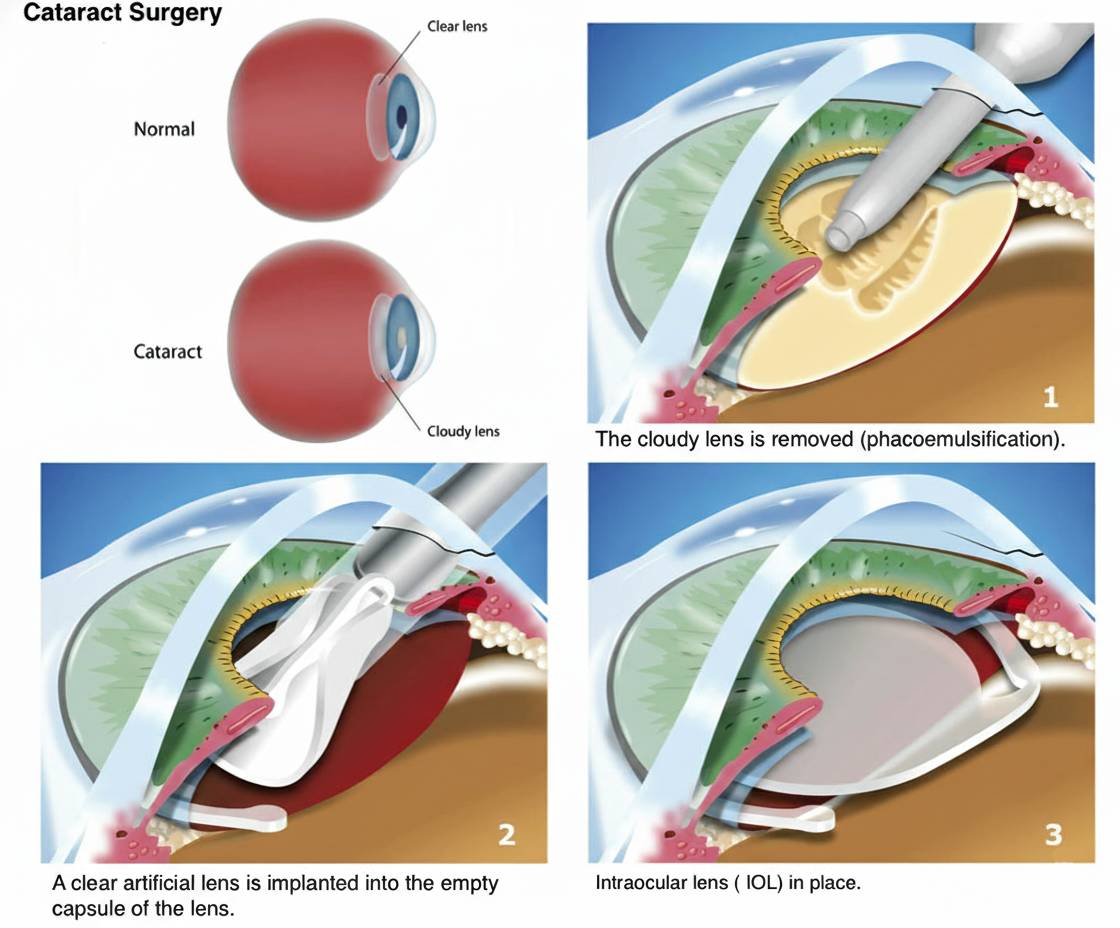
The cataract (cloudy lens) is removed and replaced with a clear artificial lens, known as an IOL (Intraocular Lens).
Modern techniques like phacoemulsification and laser cataract surgery ensure faster recovery and better outcomes.
Vision starts improving within 1–2 days, and full clarity usually returns within 1–2 weeks as the eye heals.
An IOL is an artificial lens implanted to restore clear vision. Types include:
- Monofocal IOL – sharp distance vision
- Multifocal / Trifocal IOL – distance, intermediate & near vision
- EDOF IOL (Extended Depth of Focus) – distance and intermediate vision
- Toric IOL – for cylindrical power / astigmatism
Your surgeon will recommend the best IOL depending on your eye condition and lifestyle needs.
Many patients enjoy good vision without glasses, especially for distance. However, depending on the type of IOL selected, you may still need glasses for reading or certain activities.
Yes. Modern cataract surgery is one of the safest surgeries in the world, with complications occurring in less than 1% of cases when performed by an experienced surgeon.
For the first 1–2 weeks:
- Avoid rubbing or pressing the eye
- Avoid swimming or dusty environments
- Avoid heavy lifting
- Avoid washing the eye for 5–7 days (or as advised by your doctor)
Most patients resume daily activities within 2–3 days, depending on their job and healing.
The cataract does not return.
However, the natural membrane behind the IOL may become cloudy later (called Posterior Capsular Opacification – PCO).
PCO is easily treated with a quick, painless YAG Laser Capsulotomy
- Blurry or hazy vision
- Poor night driving
- Glare or light sensitivity
- Faded or dull colours
- Frequent changes in glasses prescription
If both eyes have cataracts, surgeries are done one eye at a time, usually 1–2 weeks apart. Most hospitals avoid operating both eyes on the same day for safety reasons.
Yes. Most insurance policies cover standard cataract surgery. Premium lenses (Multifocal / Trifocal / Toric) may involve additional charges depending on your plan.
Untreated cataracts continue to progress, causing:
- Worsening vision
- Difficulty performing normal tasks
- Complications such as lens-induced glaucoma
Laser cataract surgery uses a Femtosecond Laser to:
- Soften and break the cataract
- Make precise, computer-guided corneal incisions
- Create perfect capsulotomy for accurate IOL positioning
Laser cataract surgery is preferred by many patients seeking advanced and highly precise cataract treatment.